


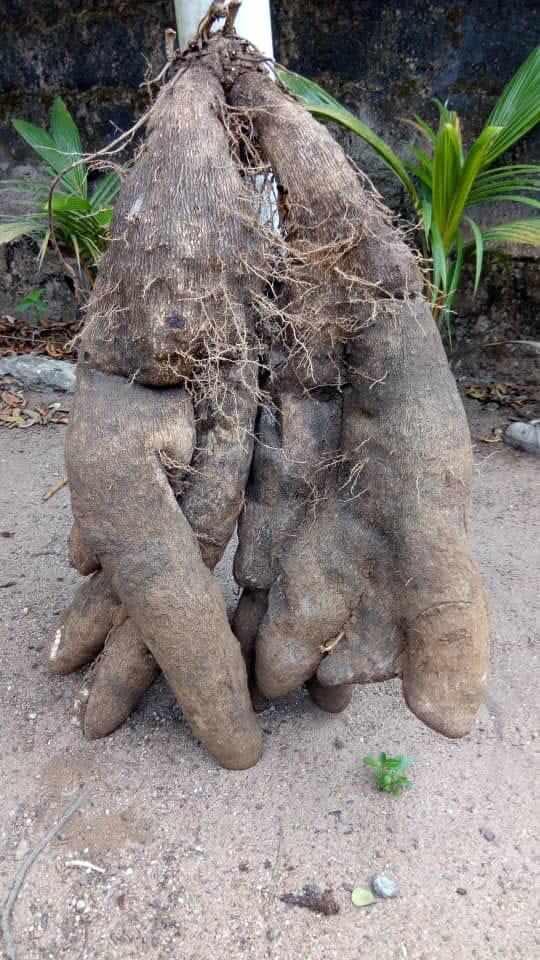
Yam festival is perhaps the most important ceremony in Amaekpu (and Ohafia). It has continued to be an integral part of the lives and culture of the people throughout history despite the progressive erosion of culture by Christianity.
The men traditionally own the yams, while the women own the cassava, and before now, the wealth and status of a man was determined by the number and size of his yam barn (oba ji)
The Yam Priest (Eze Ji) is the spiritual head of the community and he is the first to plant, harvest, and eat the new yarm. Amaekpu has two Yam Priests: the Eze Ji Nde Ofali (senior), and Eze Ji Amoba (junior).
The ceremonies start in November when the Eze Ji offers sacrifice for good health and bountiful harvest and clears the land for planting. Around February of alternate years, the women from Nde Edike compound perform the Uzoiyi festival, a female fertility cult in honour of the deity of water to help usher in fertility of the women and of the land. Thereafter, everyone begins to make preparations for yam planting.
A particular Orie market day called “Orie Okpu Odo” is selected to usher in the planting season. While the men (assisted by all family members) plant the yams, the women plant vegetables, maize, African beans and melons after the traditional iru akuku ceremony is performed by the Eze Nde Inyom.
Omume Igwa Ali is performed around early May to conclude the planting season and appease the land for a favourable harvest. This is followed by the Ekpe Iko Ji ceremony and rounded off by the appeasements at individual family ududu, where each family thanks their ancestors for a healthy planting season and prays for a bountiful harvest. This officially marks the beginning of famine season (unwu), a period marked by an acute scarcity of yams.
By the end of July/early August depending on the lunar calendar, the Eze Ji offers supplications to the ancestors and proceeds in the middle of the night to the farm for harvest. He will speak to one until he returns with the yam. Everyone stays away from his path and more importantly, he is not to be seen by women until he returns. Only a few select initiates are allowed to go with him. As soon as he harvests the first yam, he beats his gong while singing “unwu alaa, unwu alaa” to signify the end of famine. He authorizes the assistants to raid neighboring farms for vegetables and more yams. When they get home in the morning, the Eze Ji leaves some yam on the way and displays the rest at the shrine. He uses these to prepare porridge (ipuo) with the vegetables and the whole village is invited to the “ira ipuo” ceremony. Later, he retrieves the yams he left on the way and these meant for him alone.
F our days after this initial harvest, everyone is allowed to harvest small quantities of yam for food only. Large scale harvest
 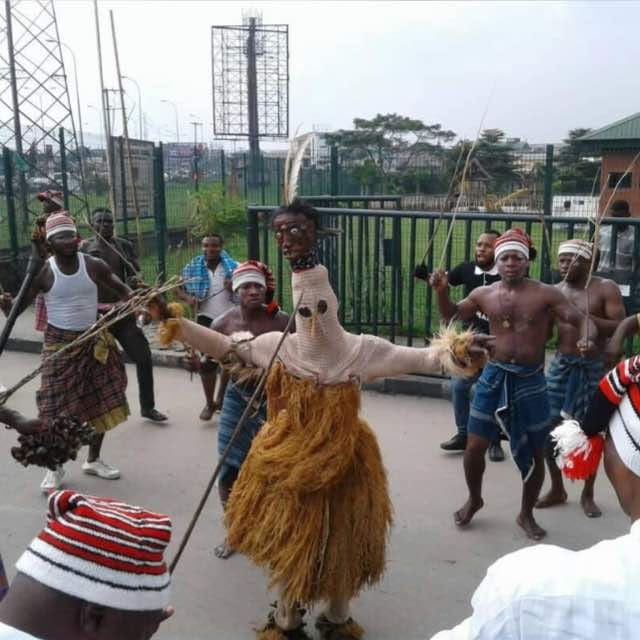 and selling of the yam is strictly forbidden at this stage. Within this period, the age grade next in line for Otuomu “Uke no Ogo” lines up in their colourful uniforms every morning and evening to perform the “oyeregbe” dance around the village. The town crier changes from “ogele” to drum for announcements, and the masculine traditional secret societies begin to perform day and night. A day is fixed, usually about 16 days from the Eze Ji harvest, to perform the Iri Ji festival with the Ekpe umirima (kids’ masquerade) and Ekpe Ukwu Amaekpu (Big Masquerade) as the main highlights of the period. Thereafter, everyone is permitted to harvest as desired.
Before the 1960s, the “Ike Oba”, “Igwa Oba”, and “Nnu” society were key aspects of the culture that tied a man’s social status to the size of his yam barn. A research by the Late Ezieogo Amaekpu Prof E. O. Arua revealed that the last “Nnu” initiation in Amaekpu occurred in 1952. A young man performs “Igwa Oba” to signal his attainment of 2 full yam barns. First, he invites his age grade members to tie and inspect his barn (Ike Oba). If they are satisfied that he has 2 full barns, they acknowledge with gun shots. He thereafter invites the community to a lavish feast (Igwa Oba) to celebrate his barns. The man is admitted into the very exclusive “Nnu” society if he attains 5 full barns (about 1000 yam tubers). The admission fee is very high, and the ceremony is often so expensive that it is not for the faint hearted. Members are given titles such as “Okogbua” and “Ogbuji”
The current Ezeogo in Council has commenced initiatives to revive some of these traditions.
For more details of Yam Ceremonies in Ohafia in general, Please refer: Arua, E. O. (1981). Yam ceremonies and the values of Ohafia culture. Africa, 51(2), 694-705.