


ADU GIANT STRIDES IN EDUCATION
 The establishment of Hope Waddle Institute at Calabar was like a force that propelled ADU leaders by giving them an insight and enlightenment needed for their children, relatives, and wards to acquire western education. Hope Waddle became a yardstick to measure intelligence quotient, and performance index. Whoever as much as passed the admission test was considered brilliant. It was like gaining admission into the modern day Cambridge so to speak. Suffice it to say that Hope Waddle Institute was an institution made for the exceptionally brilliant students. Little wonder we have names such as Professor Eme Awa, Reverend Awa Ugbaga, Mr. Dike Nze Dike, Dr. Agbai Njoku, Dr. Kalu Okpo, Bar. Eke Obuba, and many others too numerous to mention here that passed through the institute. Some of them benefiting from the scholarship awarded by ADU and Ohafia Development Union. These great Amaekpu sons had the privilege of leading Amaekpu, and indeed Nigeria at various levels.
From the foregoing, it was not therefore surprising that education occupied a pride of place on the developmental agenda of ADU. Both the pioneer leaders, and their successors put their hands on the plough to push education to a new level. Emphasis was placed on the Girl Child education at some point. In the 1940s and earlier, the ADU discovered to their chagrin that school enrolments of the Girl Child were as discouraging as it was worrisome. Only the boys were encouraged to enrol in school. The answer was not farfetched because, the belief then was that girls with all their education and qualifications would eventually end up in the kitchen. Such was the erroneous belief, and general notion about our women then. All that have changed over time.
However, in Asaga about the same period, the story was different. After a Catholic mission built a school in the area, Asaga girls were opportune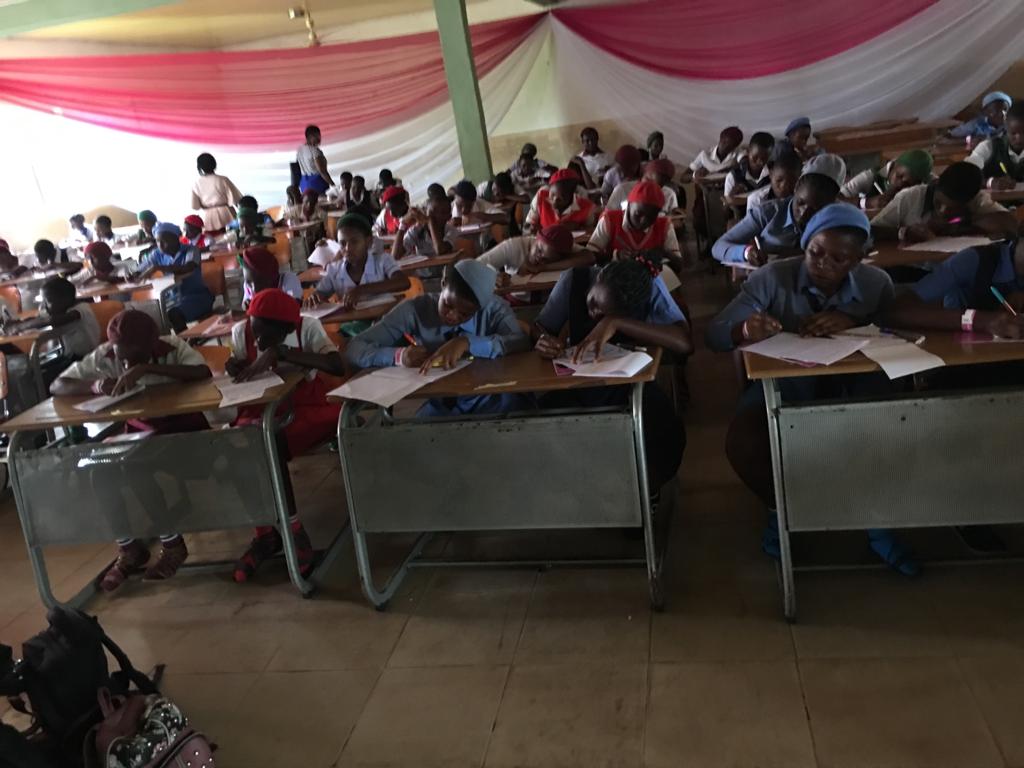 and encouraged to enrol in the school. Expectedly, they became better positioned than their counterparts from other villages. The presence of the Rev; Sisters also served as a big boost. They were like role model in the minds of these impressionable young women. Thus, Asaga took the lead in Girl Child school enrolment in the whole of Ohafia.
Ebem and Amuke, on the other hand, leveraged on their positions as the closest neighbouring villages to enrol as many female children as possible that were willing to go to school. Considering all the above factors, ADU awarded scholarship to about 40 girls for enrolment in school. One of the beneficiaries of such benevolence was Mrs. N. N. Agwu, who served as the Head Mistress of Ofali Agwu Primary school for many years. The gesture considerably closed the huge gap in female school enrolment between Amaekpu and other villages.
Aside scholarship award, ADU also built and equipped the Okpocha primary school at Ugwuorji. The school which was offici ally opened in 1978, turned out its first product in 1984.
The role played by ADU in the establishment of Ohafia Girls Secondary School in 1972 is also worthy of note. Before the centre was converted to a secondary school, it served as a model school for craft centre before the Nigerian Civil War. The school was equipped by the government, while erection of structures was the exclusive preserve of ADU, and Age Grades. It was under the auspices of ADU that the school Assembly Hall was completed and handed over to the schools by the IKEJIMBA AGE GRADE.
As a result of the encouragement given to the school in particular, and education in general, the enrolment of girls in schools tremendously increased in leaps and bounds. These innumerable contributions by ADU undoubtedly positioned Amaekpu women as leaders in education in Ohafia, and beyond.
The union also undertook the construction of the civic centre located at Ugwu. The civic centre which also serves as prayer hall was constructed in the early 1950, and was sponsored by Late Chief Mba Offe who was one of the pioneer officials of the union.
During the Nigerian Civil War, the Hall was used as a classroom because, most of the schools were occupied by Biafran soldiers. Before the construction of OBIMBA Hall, the civic centre served as venue for holding meetings where matters concerning Amaekpu Community were discussed; including settlement of disputes amongst our people.
Ofali Agwu Secondary School